SAVE Plan Borrowers: FAQs About Choosing a Different Repayment Plan
A court order ended the Saving on a Valuable Education (SAVE) Plan, and, as a result, you must choose a different repayment plan. If you don’t, you’ll be enrolled in a fixed payment repayment plan.
We’re here to help you navigate the process of understanding your options, choosing a different repayment plan, and returning to repayment. This article will answer these common questions:
- Why do I need to leave the SAVE Plan?
- When am I required to change my plan?
- What happens if I don’t select another repayment plan by my deadline?
- Which repayment plans am I eligible for?
- How can I estimate my monthly payment and total amount paid under a different plan?
- What if I can’t afford my monthly payment under a different plan?
- How do I enroll in a different repayment plan?
- What should I do if I have a pending income-driven repayment (IDR) application?
- Will my previous payments still count toward IDR discharge or Public Service Loan Forgiveness (PSLF), and how does the SAVE forbearance affect my progress?
- If I’m pursuing PSLF, which repayment plan should I switch to?
1
Why do I need to leave the SAVE Plan?
A court order ended the SAVE Plan in March 2026. To learn more about that court order and its impacts, visit StudentAid.gov/courtactions. Because the SAVE Plan ended, you must select another repayment plan that you’re eligible for. Not sure if you’re enrolled in the SAVE Plan? You can check which repayment plan you’re enrolled in on StudentAid.gov. If you never applied for or were never enrolled in the SAVE Plan because you’re in school, in a grace period, or if you received a loan on/after July 1, 2026, that hasn’t entered repayment, then you don’t need to take any action. We recommend using the Repayment Calculator to explore your repayment options before your first payment is due.
2
When am I required to change my plan?
Your loan servicer will contact you with details about choosing a different repayment plan. You may have received your notice already. Most borrowers will receive notification from their servicer via email. However, if you requested not to receive communications digitally, you’ll receive your notice via postal mail. Make sure your contact information is up-to-date with your servicer and in your StudentAid.gov account.
Here’s a sample notice of what your servicer will send you:
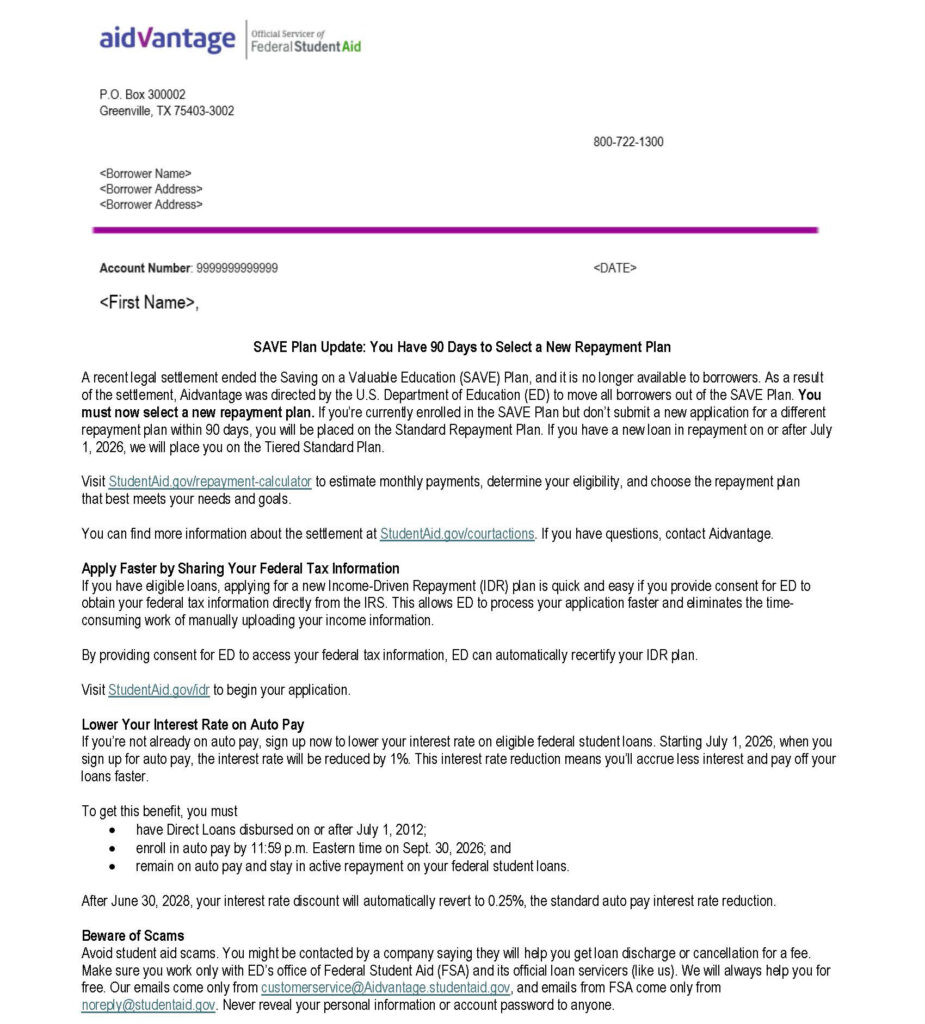
Servicers started sending notices to SAVE borrowers on July 1, 2026. Because servicers are notifying SAVE borrowers in groups, it’s possible that borrowers with the same servicer will have different deadlines to choose a different repayment plan. Before the end of 2026, servicers will notify every SAVE borrower. You can confirm when your servicer sent your message by checking your inbox on your servicer’s website.
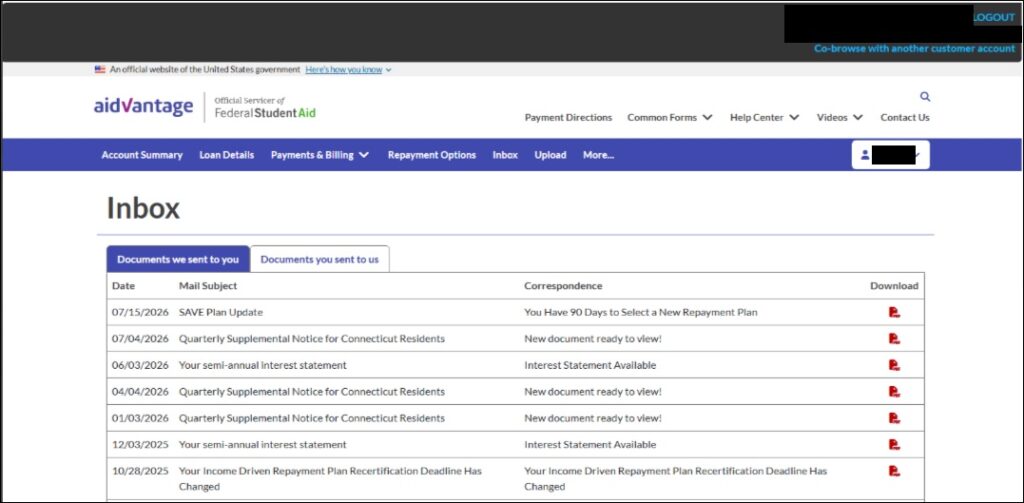
Another way to confirm your deadline is by searching your personal email inbox by subject line (“You Have 90 Days to Select a New Repayment Plan” or “Final Notice – You will be Placed into a New Repayment Plan in 30 Days”) or searching by your servicer’s email address:
| Loan Servicer | Email Address |
|---|---|
| Aidvantage | customerservice@aidvantage.studentaid.gov |
| CRI | CRINoReply@cri.studentaid.gov |
| Edfinancial | donotreply@mail.edfinancial.studentaid.gov or info@email.edfinancial.studentaid.gov |
| MOHELA | noreply@mohela.studentaid.gov |
| Nelnet | noreply@mohela.studentaid.gov |
Once you hear from your servicer, you’ll have 90 days to choose another repayment plan that you’re eligible for. For example, if you received a notice from your servicer on July 1, 2026, your deadline to select a different repayment plan was Sept. 29, 2026.
If you don’t act within that 90-day period, your servicer will send you a final 30-day notice. If you don’t choose a different repayment plan before the final deadline, you’ll be automatically enrolled in a fixed payment repayment plan.
In addition to a notice from your loan servicer, you also may have received emails from Federal Student Aid (FSA). Keep in mind that your 90-day timeline for switching plans is based on when you receive your servicer notice, not when you receive an email from FSA.
3
What happens if I don’t select another repayment plan by my deadline?
If you don’t choose another repayment plan by the servicer’s final 30-day deadline, you’ll automatically be enrolled in either the Standard Repayment Plan or the Tiered Standard Plan. The plan you’ll be enrolled in depends on when you received your loans. If you haven’t received any loans on or after July 1, 2026, then you’ll be enrolled in the Standard Repayment Plan. If you received a loan on or after July 1, 2026, and that loan has entered repayment, then you’ll be enrolled in the Tiered Standard Plan.
Your monthly payment on the Standard Repayment Plan or the Tiered Standard Repayment Plan may be higher than if you enroll in an income-driven repayment (IDR) plan. If your monthly payment amount goes up and you’re enrolled in auto pay, then your automatic withdrawal amount will also increase. Your loan servicer will notify you about your new monthly payment amount at least 21 days before the first due date on your new repayment plan.
We highly recommend that you explore your options, including other IDR plans, and consider enrolling in an available plan today to avoid being placed into a more expensive option later.
4
Which repayment plans am I eligible for?
The repayment plans available to you depend on the types of federal student loans you have and the dates the loans were first paid out (i.e., disbursed).
Log in to StudentAid.gov and visit your Dashboard to confirm your loan types and disbursement dates.
If your loans were disbursed before July 1, 2026, the following fixed repayment plans are available:
If you have a loan disbursed on or after July 1, 2026, the only fixed payment repayment plans option is the Tiered Standard Plan.
Use the chart below to see what income-driven repayment (IDR) plan(s) you’re eligible for based on your situation:
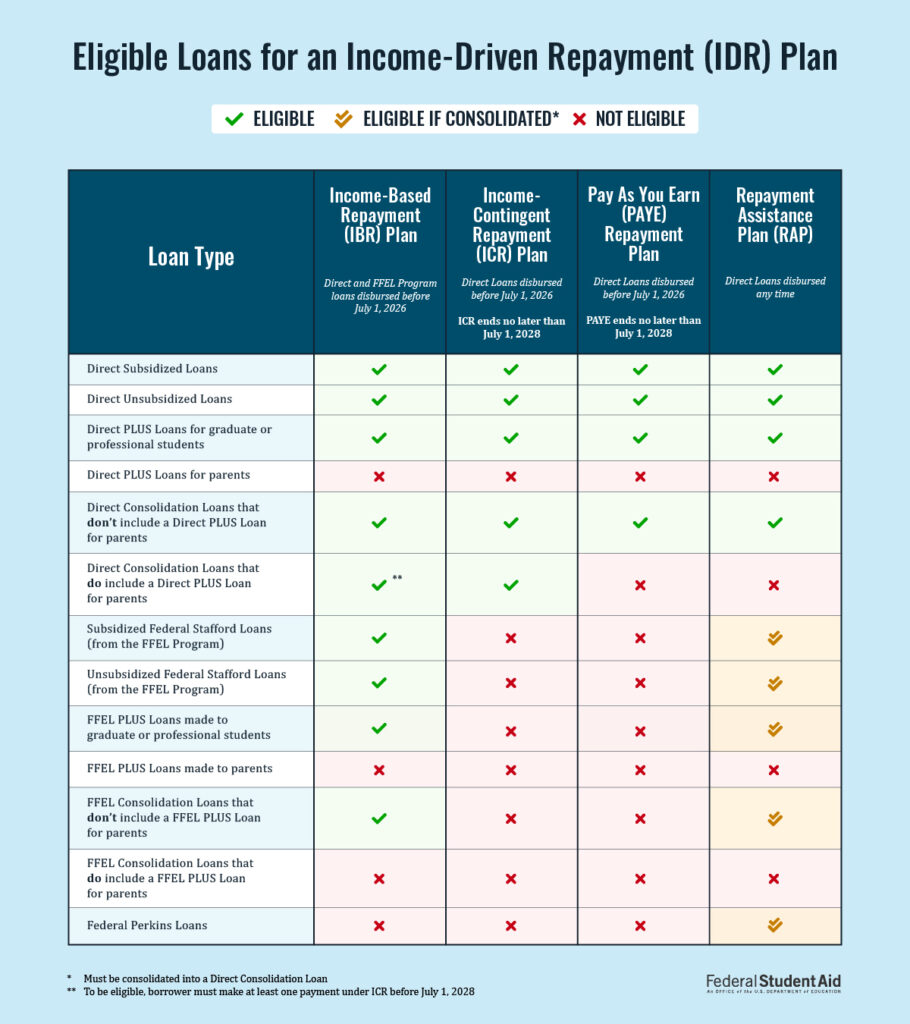
Before you consolidate: Consolidation creates a new loan and will change your repayment options. Review your personalized results and confirm how consolidation could affect your existing benefits and payment counts.
If you have a mix of loan types or disbursement dates, some of your loans may be eligible for certain repayment plans, while others may not be. Log in to our Repayment Calculator to see repayment options based on your specific loan and income information.
5
How can I estimate my payment and total amount paid under a different plan?
Use our Repayment Calculator to explore your repayment options. Logging in with your StudentAid.gov account lets you import your loan and income information for more accurate results. You can find examples and screenshots in “Compare Repayment Plans With Our Repayment Calculator” article.
The Repayment Calculator can show estimates for your
- monthly payment amount;
- repayment period;
- potential Public Service Loan Forgiveness (PSLF) or income-driven repayment (IDR) discharge amount;
- principal and interest paid; and
- total amount paid over the life of the loan(s).
While we recommend you use the Repayment Calculator to see personalized estimates, here’s an overview of the monthly payment amount calculation and repayment period for each repayment plan:
| IDR Plans | Monthly Payment Amount Calculation | Repayment Period |
|---|---|---|
| Income-Based Repayment (IBR) Plan | 15% of discretionary income (10% for new borrowers) Your monthly payment will never be more than the amount you would pay under the Standard Repayment Plan with a 10-year repayment period. |
25 years (20 years for new borrowers) in repayment You are considered a new borrower if your first loan was made on or after July 1, 2014, or you have no loans at the time you take out a new loan on or after July 1, 2014. |
| Income-Contingent Repayment (ICR) Plan* | The lesser of 20% of discretionary income or a monthly payment on a 12-year fixed plan, adjusted based on your income | 25 years |
| Pay As You Earn (PAYE) Repayment Plan* | 10% of discretionary income Your monthly payment must be less than what you’d pay under the Standard Repayment Plan with a 10-year repayment period. If the amount you would have to pay under the PAYE Plan is more than what you would have to pay under the Standard Repayment Plan, you won’t qualify. |
20 years |
| Repayment Assistance Plan (RAP) | 1–10% of your adjusted gross income (AGI), divided by 12 Your monthly payment amount is reduced by $50 for each dependent you claim on your federal tax return. However, your monthly payment may not be less than $10 a month. |
30 years |
*These plans will end no later than July 1, 2028
Fixed monthly payments mean you will pay the same amount every month until the loan is paid off. Graduated payments are lower at first and then increase, usually every two years.
| Fixed Repayment Plans | Monthly Payment Amount Calculation | Repayment Period |
|---|---|---|
| Extended | Fixed or Graduated | 25 years |
| Graduated | Graduated | 10 years (within 10–30 years for Consolidation Loans) |
| Standard | Fixed | 10 years (10–30 years for Consolidation Loans) |
| Tiered Standard | Fixed | 10 years for balances under $25,000 15 years for balances under $50,000 20 years for balances under $100,000 25 years for balance over $100,000 |
Before switching, compare how each repayment plan will affect your interest, principal balance, and potential discharge timeline. For example, switching to a plan with a lower monthly payment over a longer repayment period can result in more interest paid over time and increase your timeline to receive IDR discharge.
Borrowers who make full, on-time monthly payments on RAP will receive an interest subsidy if their monthly payments don’t cover their monthly accrued interest. They may also receive a matching principal payment. Learn more about these benefits.
6
What if I can’t afford my monthly payment under a different plan?
If you can’t afford your payment on a different plan, you can request to temporarily pause or lower your payments through short-term relief (a deferment or forbearance). If this option makes sense for you, contact your loan servicer to request a deferment or forbearance.
Interest can still accrue (add up) during periods of deferment or forbearance. Deferment and forbearance can also affect loan discharge options, such as Public Service Loan Forgiveness (PSLF) or income-driven repayment (IDR) plan discharge. If you repeatedly miss payments, the consequences become more serious over time such as negative credit impacts and more.
7
How do I enroll in a different repayment plan?
Use our Repayment Calculator to explore your repayment options. Logging in with your StudentAid.gov account lets you import your loan and income information for more accurate results. After reviewing your options, select “Apply” for the plan you want to enroll in, and follow the instructions to submit your application.
If you choose an income-driven repayment (IDR) application, you can submit your application online at StudentAid.gov/idr. You must first log in to your StudentAid.gov account to access the IDR application.
Avoid scams: Help from your federal loan servicer is free. You never have to pay a company to apply for a repayment plan or manage your federal student loans.
To apply for an IDR plan, you’ll need to provide your income information. If you have Direct Loans, the easiest way to do this within the IDR application is by providing consent for us to securely access your financial information directly from the IRS. You can do this by selecting “Provide Approval” under the “Authorization To Retrieve Federal Tax Information” section of the application.
Providing consent to import your federal financial information to your IDR application allows us to process your application faster and will save you time in the future since we’ll be able to automatically recertify your IDR plan each year. Alternatively, you can manually provide documentation of income, such as your most recent tax return. If you didn’t file taxes, other acceptable income documentation includes paystubs or a letter from your employer.
You can learn how to check the status of your IDR application and more in our “Top FAQs About Income-Driven Repayment Plans” article.
Once you’re on your IDR plan, consider signing up for auto pay to make sure your payment is on time and get a discount on your interest rate. Eligible borrowers enrolled in auto pay by Dec. 31, 2026, will benefit from a 1% interest rate reduction through June 30, 2028.
8
What should I do if I have a pending IDR application?
If you have a pending SAVE Plan application
Your loan servicer will deny your SAVE Plan application. You already may have received your denial notice. If you don’t apply for a different plan within 90 days of when you receive your notice, you’ll receive a final 30-day notice. If you don’t act by that deadline, you’ll be enrolled in the plan you were on before you applied for the SAVE Plan.
Use our Repayment Calculator today to compare your options and submit a new repayment plan application. Your loan servicer will explain your account status while your new application is pending.
If you have a pending application for another income-driven repayment (IDR) plan
Log in to StudentAid.gov and review the request on your “My Activity” page.
Your request may show a status such as “Draft,” “In Progress,” “Cancelled,” “In Review,” “Action Required,” or “Completed.”
If you see “Action Required,” you’ll need to provide more information or a manual signature.
If your servicer needs more time to process your IDR application, it may place your loans in a processing forbearance for no more than 60 days.
9
Will my previous payments still count toward IDR discharge or PSLF, and how does the SAVE forbearance affect my progress?
Changing repayment plans doesn’t remove qualifying Public Service Loan Forgiveness (PSLF) payments or credited income-driven repayment (IDR) plan payments that you made before entering the SAVE forbearance.
Time spent in the SAVE forbearance is not eligible for credit toward PSLF. However, you may buy back certain months you spent in an ineligible deferment or forbearance, including the SAVE forbearance, when you already have 120 months of qualifying employment. If you’re pursuing PSLF, you’ll reach your required 120 qualifying monthly payments faster by starting payments on a different, PSLF-eligible repayment plan.
Time spent in the SAVE forbearance also doesn’t provide credit toward IDR discharge. If you switch to an available IDR plan, you’ll be eligible to have any remaining balance on your loans discharged once you reach the necessary number of payments, which depends on your repayment plan.
If you take out a new Direct Consolidation Loan, the qualifying payments made on the Direct Loans (other loan types will not be considered) included in your consolidation loan will be credited to your consolidation loan using a weighted average of those payments.
For example, a borrower with 60 qualifying payments on a Direct Loan with a balance of $30,000 who consolidates their loan with another Direct Loan with a balance of $30,000 with zero qualifying payments will have a new qualifying payment count of 30 payments credited to the new consolidation loan.
10
If I’m pursuing PSLF, which repayment plan should I switch to?
Qualifying repayment plans that count toward Public Service Loan Forgiveness (PSLF) include all income-driven repayment (IDR) plans:
- Income-Based Repayment (IBR) Plan
- Income-Contingent Repayment (ICR) Plan
- Pay As You Earn (PAYE) Repayment Plan
- Repayment Assistance Plan (RAP)
Payments under the Tiered Standard Plan do not count toward PSLF. Therefore, we recommend that you proactively apply for a different plan to avoid being automatically placed in this plan.
Use our Repayment Calculator to review your options and compare repayment options. Then, use the PSLF Help Tool to confirm that you have eligible Direct Loans and qualifying employment. We recommend you submit a PSLF form each year and when you change jobs.
Published: October 2026