FAFSA® Checklist: What Students Need

Get ready now to complete the FAFSA form at fafsa.gov. In this article, we cover what you’ll need to access and complete your form:
- StudentAid.gov account
- Parent or spouse information
- Federal income tax return (accessible online)
- Records of your child support received
- Records of your assets
- List of schools you’re interested in attending
Note: Some students may need to invite a parent or spouse to their FAFSA form. If you have a parent participating on your form, they’ll need items 1, 3, 4, and 5 in the list above. If you have a spouse participating on your form, they’ll need items 1 and 3 in the list above.
1
StudentAid.gov Account
You’ll need to create a StudentAid.gov account to access and fill out the FAFSA form online.
If you have a parent or spouse contributor, they’ll need their own StudentAid.gov account. A contributor refers to anyone (you, your spouse, your biological or adoptive parent, or your parent’s spouse) required to provide information on your FAFSA form.
Your StudentAid.gov account serves as your digital signature. Since it allows you to sign legally binding documents, only you can use it.
As a student, you have to enter your Social Security number (SSN) to create a StudentAid.gov account (unless you’re a citizen of the Freely Associated States). However, if your parent or spouse doesn’t have an SSN, they can still create a StudentAid.gov account to complete their sections of your FAFSA form.
Tip: Find your SSN on your Social Security card. If you don’t have it handy, you can request a new or replacement Social Security card from the Social Security Administration.
For help creating your account, check out our How To Create a StudentAid.gov Account infographic or view the video below. To learn about the different ways you can use your account, read our “Key Facts About Your StudentAid.gov Account” article.
2
Parent or Spouse Information
The FAFSA form will ask you questions that determine if you need a parent or spouse to participate on your form.
If you’re married (and not separated) and filed taxes jointly with your spouse, you’ll report your spouse’s information on the FAFSA form but they won’t need to fill out your form. However, if you’re married (and not separated) and filed taxes separately, you’ll have to invite your spouse to your form.
If you’re a dependent student, you’ll be required to invite a parent to your FAFSA form. When your parent completes their sections of the form, they may be required to invite your other parent if they’re married (and not separated) and filed taxes separately.
Find out which parent you’ll need to invite to your FAFSA form by using our Who’s My FAFSA Parent? wizard.
Inviting a Parent or Spouse to Your FAFSA® Form
If you’re required to invite a parent or spouse to your FAFSA form, you’ll need their email address. In the “Contributor Invite” section of the FAFSA form, you’ll enter their email address to invite them to your form. For details on what happens next, read our “Steps for Students: Filling Out the FAFSA® Form” article.
If you’ll be inviting a parent to your form, share the “Steps for Parents: Filling Out the FAFSA® Form” article with them. We cover step-by-step instructions for parents, including how they’ll accept the invitation to your form.
We recommend telling your parent in advance that completing their sections of your FAFSA® form won’t make them responsible for your education costs.
3
Federal Income Tax Return (Accessible Online)
You (and your parent or spouse, if applicable) must provide consent and approval to have your federal tax information transferred directly from the Internal Revenue Service (IRS) into your FAFSA form. Consent and approval are required, even if you didn’t file a U.S. federal tax return or any tax return at all.
If you (or your parent or spouse) don’t provide consent and approval to have federal tax information transferred into the FAFSA® form, you won’t be eligible for federal student aid.
Although most of your financial information will be imported directly from the IRS when you provide consent and approval, you may need your tax records to answer additional questions.
Before you begin the FAFSA form, you can check which year’s income and tax information you’ll be required to report. Do not use a different year’s tax information.
If you or your family have significant changes to your financial situation (such as unemployment or high medical expenses), you should still complete the FAFSA® form as instructed. Then, contact your school to request an aid adjustment.
4
Records of Child Support Received
Based on your dependency status, you or your parent may see a question on the FAFSA form about child support received.
If you’re an independent student, you’ll need to enter the total amount of child support that you (and your spouse, if you’re married) received in the last calendar year.
If you’re a dependent student, your parent will need to enter the total amount of child support they received in the last calendar year.
Remember: You can check which year’s information you (or your parent) will use to answer these questions before beginning the FAFSA form.
5
Records of Your Assets
The FAFSA form asks questions about your current assets and investments, so make sure you (and your parent, if you’re a dependent student) have those records on hand. This includes the total balance of your cash (amounts more than $1,000), savings, and checking accounts; and the net worth of your businesses, investments, and income-producing farms.
Your cash, savings, and checking accounts are considered assets, not investments. (Remember: You won’t report cash amounts of less than $1,000.) Review this image to understand what is and isn’t considered an investment.
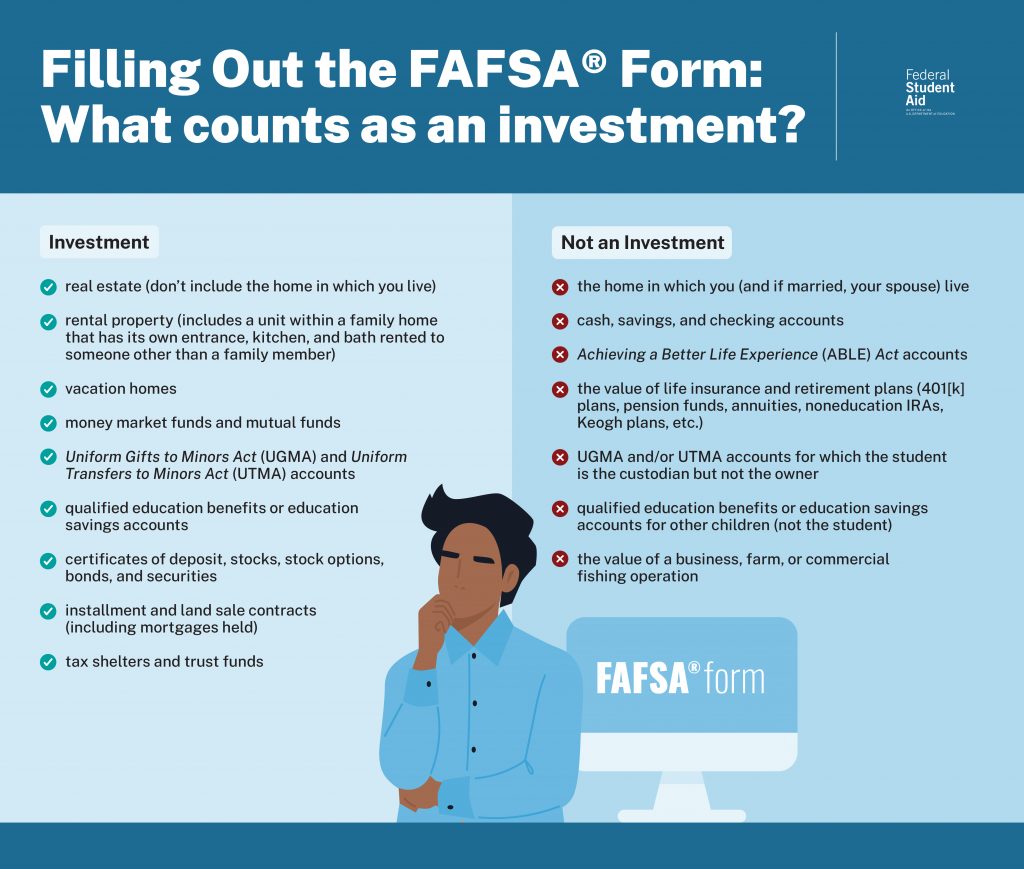
You will report the current amounts of your assets and investments as of the date you sign the FAFSA form—not the tax year amounts.
For details, read our help article on how to report the net worth of businesses and income-producing farms.
6
List of Schools You’re Interested in Attending
You can add up to 20 schools on the online FAFSA form—and you need to add at least one to submit it. Create a list of the colleges, career schools, or trade schools you’re considering even if you haven’t applied or been accepted yet.
Make sure to enter all of these schools on your FAFSA form. You can always remove a school later if you decide not to apply. If you wait to add a school, you could miss out on financial aid since each school may have its own priority deadline.
After your FAFSA form is processed, the schools you list on the form will receive your results electronically. They’ll use your information to determine the types and amounts of financial aid you may be eligible to receive.
If you add a school to your FAFSA form and later decide not to apply for admission, that’s OK! The school likely won’t offer you aid until you’ve been accepted anyway.
Tip: Some states require you to list schools in a particular order to be considered for state aid. For instance, you might need to list a state school first. Check your state’s guidance for listing schools on the FAFSA form.
Ready to apply for federal student aid?
Start your FAFSA form at fafsa.gov. For tips on completing the form, visit our “Filling Out the FAFSA® Form” page and our “Steps for Students: Filling Out the FAFSA® Form” article.
Any information that you and your parent or spouse provide on the FAFSA form is protected. The U.S. Department of Education follows several laws and regulations to handle your information responsibly.
Remember: Completing and signing the FAFSA form doesn’t mean you (or your parent or spouse) are legally bound to accept federal student loans.
Published: September 2026