How To Avoid Student Loan Scams
Federal Student Aid now sends emails from only the following addresses: noreply@studentaid.gov, noreply@login.studentaid.gov, noreply@mail.studentaid.gov, and noreply@info.studentaid.gov.
Student loan scams can come by phone, email, text, social media, or online ads. Scammers may impersonate Federal Student Aid or your loan servicer, promise unrealistic benefits, or try to steal your money or personal information. Learn how to recognize the warning signs and protect yourself.
In July 2026, the Federal Trade Commission (FTC) announced action against operators of a student loan debt-relief scheme that took more than $45.9 million from consumers. Scammers may promise quick student loan discharge (sometimes called forgiveness), charge you for services to enroll in repayment plans to reduce your monthly payment, which you can get for free, or ask for personal information they shouldn’t need. They may also impersonate Federal Student Aid or your loan servicer. If you need help with federal student loans, you can get trusted information and assistance for free through StudentAid.gov and your official loan servicer.
In this article, we cover these key questions about student loan scams:
- What are the warning signs of a student loan scam?
- How can I tell if a Federal Student Aid message is legitimate?
- Who are legitimate federal student loan servicers and what do they do?
- Should I pay for help with my student loans?
- What should I do if I think I’ve been scammed?
Remember: A scam doesn’t have to be elaborate or complex.
It’s common for fraudsters to mention legitimate programs and try to scam you into paying them for programs and resources you can access for free. Examples of legitimate programs and resources available to help you with your federal student loans include:
- Income-Driven Repayment Plans,
- Federal Direct Consolidation Loan Program,
- Public Service Loan Forgiveness (PSLF) Program, and
- Teacher Loan Forgiveness Program.
You can work with your loan servicer to explore all your options—free of charge. For specific questions about PSLF, check out our “How to Manage your Public Service Loan Forgiveness (PSLF) Progress on StudentAid.gov” article.
Many scammers will try to take advantage of borrowers by guaranteeing immediate results or requesting money up front for services they can’t provide.
1
What are the warning signs of a student loan scam?
Scammers change their tactics as student loan programs and news change, but the warning signs are often similar. Be careful if someone contacts you unexpectedly, pressures you to act quickly, promises guaranteed results, asks for money up front, or requests personal account information.
Unexpected Contact or Pressure To Act Quickly
Scammers may contact you by phone, email, text message, social media, search results, or online ads. FTC data published in 2026 showed that, across all scams, nearly 30% of people who reported losing money in 2025 said the scam started on social media. Scammers often create urgency, so you act before you have time to verify what they are telling you.
Examples of suspicious claims may include:
- “Act now to qualify before the program closes.”
- “You have been preapproved for student loan relief. Call immediately.”
- “Your student loan account is flagged for forgiveness pending verification.”
Unexpected contact does not automatically mean a message is a scam, but don’t let urgency stop you from checking the information through StudentAid.gov or your official loan servicer.
Promises of Guaranteed or Immediate Forgiveness
Be skeptical of anyone who promises immediate student loan cancellation, guarantees that you qualify for forgiveness, or claims to have special access to a federal program. Eligibility for repayment, discharge, and forgiveness programs depends on your individual loans and circumstances.
You can review federal repayment plans and discharge and forgiveness options on StudentAid.gov without paying a company to tell you whether you may qualify. Most federal government discharge and forgiveness programs require years of qualifying payments and/or employment in certain fields before discharging loans.
Requests for Up-Front Fees
You don’t have to pay a company to enroll in a federal repayment plan, consolidate federal student loans, or apply for federal student loan discharge or forgiveness. Your federal loan servicer can help you with these services for free.
The FTC cautions that an up-front payment demand before repayment services are provided is a scam warning sign. Be especially wary of a company that guarantees fast loan discharge, forgiveness, or debt cancellation. Once again, most federal government discharge and forgiveness programs require years of qualifying payments and/or employment in certain fields before discharging loans.
Requests for StudentAid.gov Log-In Information
Never share your StudentAid.gov username or password with another person or company. Your StudentAid.gov account has sensitive federal student aid information and serves as your electronic signature for certain forms.
Be cautious if an unexpected caller or message asks you to share a secure code used to access your account or to approve a log-in you did not initiate. Go directly to StudentAid.gov if you need to review or update your account.
The U.S. Department of Education and our partners—including loan servicers—will never ask for your StudentAid.gov username and password.
Official-Looking Names, Seals, Caller IDs, or Websites
A message can look official and still be a scam. Scammers can copy government seals and logos, create look-alike websites, mimic a legitimate phone number (known as spoofing caller ID), and impersonate government agencies or businesses.
The FTC reported in 2026 that imposter scams were the most frequently reported fraud category in 2025. Don’t use a phone number or link from an unexpected message to verify the message itself. Instead, go directly to StudentAid.gov or use the contact information shown in your StudentAid.gov account.
2
How can I tell if a Federal Student Aid message is legitimate?
Know what official Federal Student Aid communications look like, and remember that the safest way to verify an unexpected message is to go directly to a trusted source rather than clicking a link or calling a number in the message.
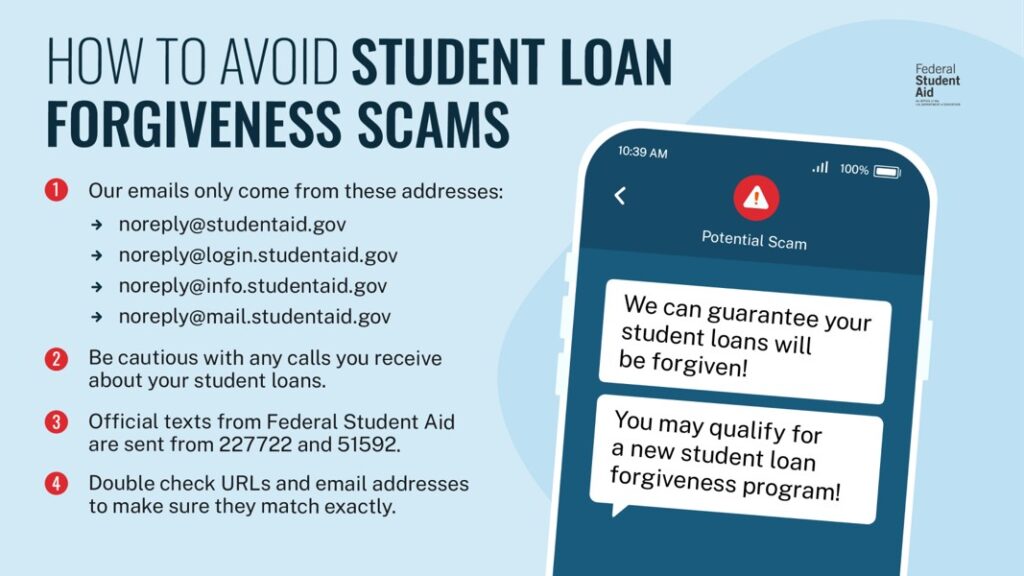
Emails from us will only come from these addresses:
- noreply@studentaid.gov
- noreply@login.studentaid.gov,
- noreply@mail.studentaid.gov
- noreply@info.studentaid.gov
Text messages from us will only come from 227722 or 51592.
Still not sure if you’re being scammed? You can check with your local Better Business Bureau® to see if a company has any complaints.
3
Who are legitimate federal student loan servicers and what do they do?
Federal student loan servicers are companies that work on behalf of the U.S. Department of Education to support borrowers. Your servicer can help you
- make and manage loan payments,
- understand your loan balance and account status,
- compare repayment options,
- apply for or switch to an eligible repayment plan, and
- get information about federal consolidation and discharge options.
You don’t need to pay someone to help you manage your federal student loans. To find your current servicer, log in to StudentAid.gov and review the “My Loan Servicers” section of your account.
Review the list of official federal student loan servicers before responding to a company that contacts you about your loans.
| Loan Servicer | Contact |
|---|---|
| Aidvantage | aidvantage.StudentAid.gov |
| CRI | cri.StudentAid.gov |
| Default Resolution Group | myeddebt.ed.gov |
| ECSI | efpls.ed.gov |
| Edfinancial | edfinancial.StudentAid.gov |
| MOHELA | mohela.StudentAid.gov |
| Nelnet | nelnet.StudentAid.gov |
4
Should I pay for help with my student loans?
No. If you have federal student loans, start with StudentAid.gov or your loan servicer. You can get help with federal repayment plans, consolidation, and discharge options for free.
A private company offering repayment services is not automatically a scam. But walk away if a company
- demands payment before providing federal student loan services,
- guarantees that your student loans will be discharged or canceled quickly,
- claims to be affiliated with the U.S. Department of Education when it is not,
- asks for your StudentAid.gov username or password, or
- tells you to stop communicating with or paying your legitimate loan servicer.
If you are unsure whether an offer is valid, do not pay or share information until you verify it through StudentAid.gov or your loan servicer.
5
What should I do if I think I’ve been scammed?
Act quickly. The right steps depend on what information or money you’ve shared, but consider doing the following:
- Stop communicating with the suspected scammer and do not send additional money or information.
- Log in to StudentAid.gov directly and review your account. If you’ve shared your account credentials, change your password as soon as possible.
- Check your contact information and two-step verification methods to make sure they have not been changed.
- Check with your federal loan servicer to confirm that no unauthorized actions were taken on your loans.
- Contact your bank or credit card company if you paid the suspected scammer to see if they can stop or reverse the payment.
- Submit a complaint through the Federal Student Aid Feedback Center.
- Report the scam to the Federal Trade Commission at ReportFraud.ftc.gov.
- If your personal information was stolen or misused, visit IdentityTheft.gov for a recovery plan.